

I was watching a debate between an atheist and a Christian, and the atheist asked this question:
“Where did God come from?”
The Christian answered, “That question assumes God is the kind of thing that came into existence. The Christian God didn’t begin to exist. He is the source of space and time themselves.”
This is a point I missed as a child. The Christian God is not a very large, very old object inside the universe. He created space and time, and is not contained by either. Many people, like this atheist and my younger self, argue against a God the Christian tradition never described.
You can reject the actual claim. But it’s worth rejecting the real one, and not a strawman.
I think of my role as a translator. That’s why I started Fractal Faith: not to say anything Christianity isn’t already saying, but to find words and images that might make its claims easier to see. This idea is no different.
I often use images to carry complex ideas, and I’ll do that here. Below is an image I made of Christ, who is God, entering space and time. The wheel is a calendar, twelve months of a single year, the way Carl Sagan compressed the history of the universe into one. I used that idea in The Fractal Nature of the Pit.
Sagan’s calendar usually humbles us. All of recorded human history fits into the last few seconds of December 31. I love that image, and it makes what I’m about to show you hit harder.
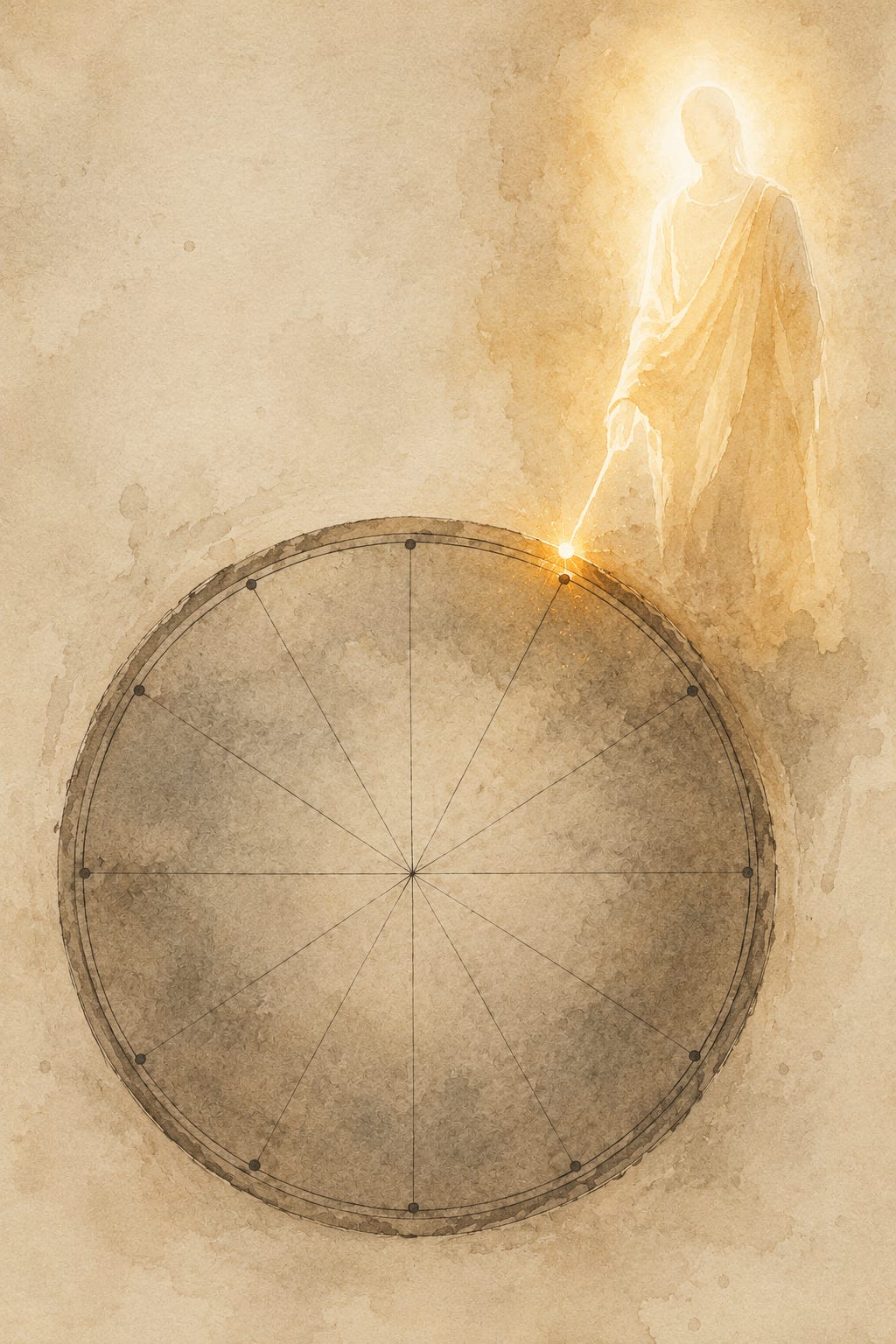
Notice Christ is not inside the wheel, a part of creation, but outside of it—the source of creation.
Then, astonishingly, he enters it.
The Word, who is Christ, becomes flesh and is born of Mary, a baby in a manger in Bethlehem.
It’s tempting to think that’s when Christ began, with a child in a stable. Yet Jesus himself said, “Before Abraham came into existence, I AM.” John opens his Gospel with the same claim: “In the beginning was the Word, and the Word was with God, and the Word was God... All things were made through him.” And Paul writes that “he is before all things, and in him all things are held together.”
The birth is the moment the one who stands outside time took on a human life within it. He is fully God and fully man.
By the way, one inspiration for how I think about images comes from the Eastern Orthodox tradition of iconography. Icons aren’t snapshots. They carry a great deal of information at once.
Take this icon of Christ’s birth:
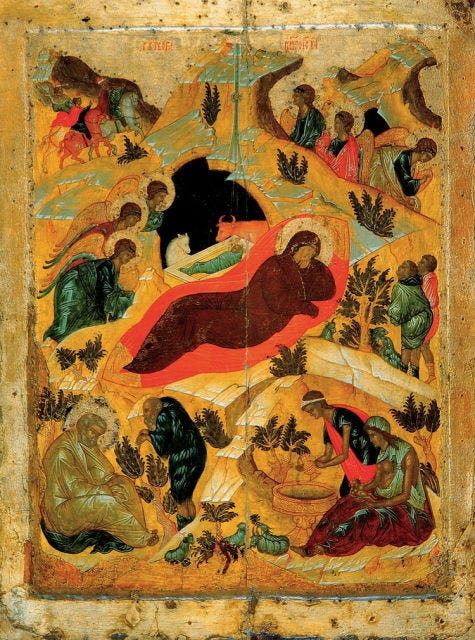
Russian icon of the Nativity, early 18th century. Morsink Icon Gallery, via Wikimedia Commons.
Look for the infant. He’s in the manger at the center, with the ox and the donkey. He’s also in the lower right, in his first bath. The angels sing above while the magi kneel with their gifts, and at the right an angel is still telling a shepherd the news. A photograph chooses a single moment. An icon compresses many moments into one.
That’s what I was trying to do with my image. It doesn’t show a scene, but an idea: eternity and time in one frame.
I’m curious whether my image makes the idea easier to see.
I plan on building a library of these over time, to help people understand what Christianity is actually claiming.
Because the claim is grand. And I believe it’s true.