

Scale has always fascinated me. As a kid, I had Carl Sagan’s Cosmic Calendar taped to my bedroom wall. It’s a poster that compresses the entire 13.8-billion-year history of the universe into a single year.
The Big Bang happens at midnight on January 1st. Earth appears in September. Human beings don’t show up until December 31st at 11:54 pm.
Practically the whole year passes before we arrive.
That poster rewired how I think about time. A century feels enormous, but on the Cosmic Calendar, all of recorded human history fits inside the year’s last few seconds.
Suddenly, the phrase “a long time” took on a different meaning. Are we talking about a long time waiting for the airplane? Or a long time between Earth and humans appearing?
It depends on the context, of course. But here’s the strange thing… regardless of the actual number, whether it’s one thousand seconds or one thousand centuries, you see the same patterns.
And it doesn’t only apply to time. Almost everywhere you look, the same rules apply at every scale. The same pattern that shows up at one size shows up at every size.
River systems.
Trees.
Families.
Careers.
The life of Christ.
My first article claimed that Christianity works less like a religion and more like an explanation of reality. It was the fractal nature of reality that really gave me that "aha” moment.
Seeing reality as fractal may unlock it for you, too.
If the word “fractal” confuses you, don’t worry, it’s not that scary. I encourage you to make it an everyday term, because it will change how you see and think.
A fractal is a repeating pattern at different scales. By scale, think of size. There are smaller scales and larger scales. Russian dolls are a great example. The same pattern—the doll—repeats at different sizes.
The best way to see fractals is to look at examples. Check out the pictures on this Fractal Thinking post I wrote a few years back. See enough fractals, and they’ll click.
You’ve likely seen side-by-side images like the one below. Is it a river system, or a human body’s nervous system?
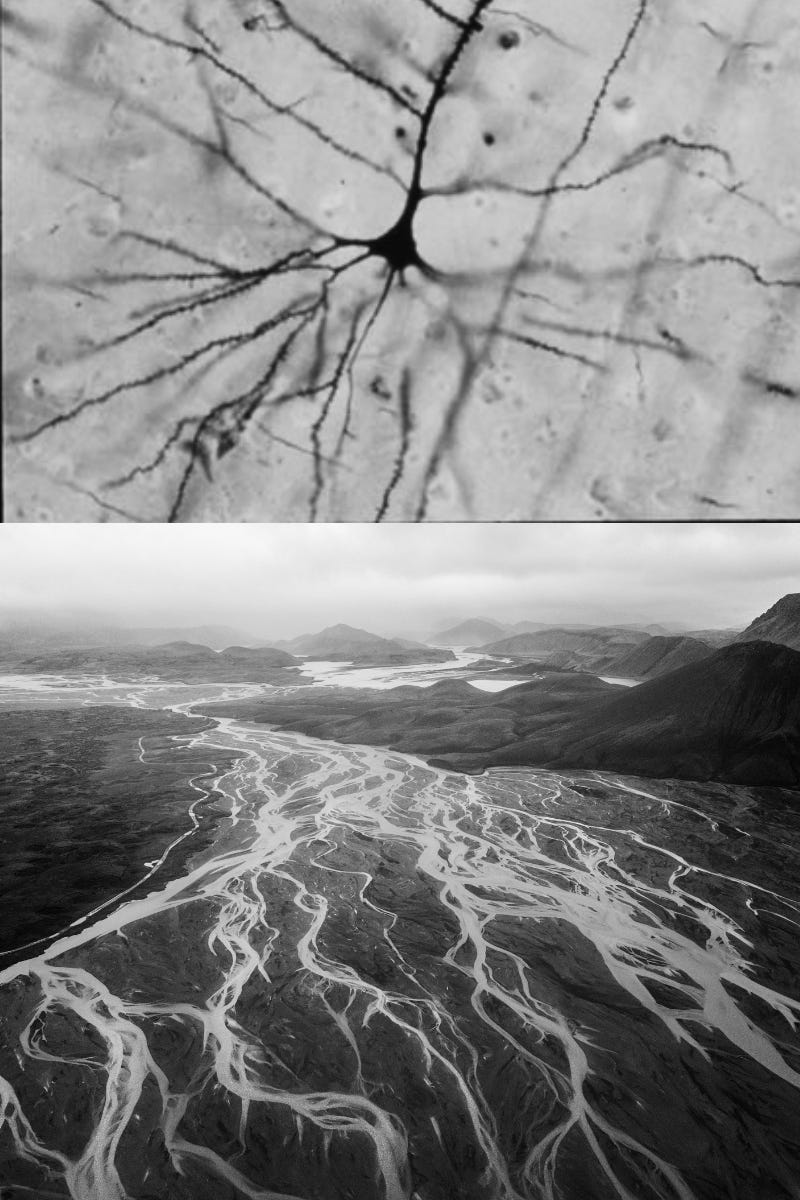
“Neuron” by Bob Jacobs, Colorado College — CC BY-SA 3.0 (via Wikimedia Commons)
That’s kind of a wild question, isn’t it?
The Mississippi delta is 200 miles long, while the average height of a human is 5 feet 8 inches. Shouldn’t it be obvious which one is which? The size difference is enormous.
That’s the astonishing fact of fractals—they make scale irrelevant. Why does this matter? Because the same rules apply at every scale.
It could be mathematical rules. Let’s say we figured out a mathematical pattern to the human nervous system. Perhaps the nerves branch at certain intervals and angles.
Without fractal thinking, still blinded by the scale gap, like the gap between a human body and a river system, we might never think to apply the same rules.
But when we think fractally, and we make a discovery at one scale, we immediately recognize that our “aha” moment applies to other scales. The hydrologist who discovers a mathematical pattern in a tiny backyard creek may immediately realize it explains the behavior of the entire Mississippi River.
How this Applies to Christianity
Fractal thinking matters for Christianity because when we can see the same pattern at different scales, we begin to see God in everyday moments, even the small ones. God can be intimidating if we think of him only as big, cosmic, and removed from our day-to-day. But the fractal thinker sees no such separation.
Take Jesus Christ. In the Christian worldview, he was not some ordinary guy. He was God himself: fully God and fully human. And he did not first appear in the first century, but was there since the beginning of the universe.
Look at this Bible verse from the Gospel of John:
“In the beginning was the Word, and the Word was with God, and the Word was God. He was with God in the beginning. Through him all things were made; without him nothing was made that has been made... The Word became flesh and made his dwelling among us.”
John 1:1-3, 14
Focus on this line: through him all things were made.
Do you see how this is a much larger claim about Jesus than the average person understands? I attended Catholic school as a child and never learned this about Jesus. He was not just a moral teacher. The entire universe was created through him.
In other words, Christianity explains the underlying structure of the universe.
Back to fractals. The universe was created through Jesus Christ, and Christ left a fingerprint. Every created thing carries it. Look closely enough at anything… a tree, a sparrow, your crappy Tuesday afternoon… and you’re looking at a piece of Christ.
Christians have a word for that fingerprint: logos, lowercase. And a word for Christ himself, the one behind every fingerprint: Logos, uppercase.
Saint Maximus the Confessor, a 7th-century theologian, built an entire doctrine around the logoi . Every created thing has a divine principle embedded in it, each logos a particular expression of the one Logos, Christ.
“To contemplate any creature deeply is to contemplate an aspect of the Logos... would he not know that the one Logos is many logoi?”
— St. Maximus the Confessor
One Logos, many logoi.
One Russian doll, many dolls inside.
Fractals.
How Fractals Show up in The Pit
Go back to our river example. Let’s imagine the largest version of that fractal is the Mississippi river and the smallest is the backyard creek. If reality was created through Christ and if reality is fractal, we might expect a similar structure.
What is the largest pattern of reality? It’s the incarnation of Jesus Christ.
Remember that Cosmic Calendar poster on my wall? Jesus is born at 11:59:55 pm, which is five seconds before the calendar runs out. And yet John’s Gospel opens by telling us: “In the beginning was the Word... through him all things were made.”
Jesus had been holding the calendar since the beginning. At near midnight, he stepped into it.
God enters his creation and becomes man in Jesus Christ
Christ dies on the cross
Christ enters death, Hades, and defeats it
Christ rises from the dead, still fully God and fully human
Christ ascends into heaven and returns in glory to God the Father
Now let’s apply fractal thinking. Someone might accept the incarnation yet think, “Sure, but that’s all on a grand scale. It’s cosmic. How does Christ’s incarnation apply to my everyday life?”
The fractal thinker sees the connection immediately. The same rules that apply at the cosmic scale apply at every lower scale. This meta-pattern is what I demonstrated in my previous post, “The Pit.”
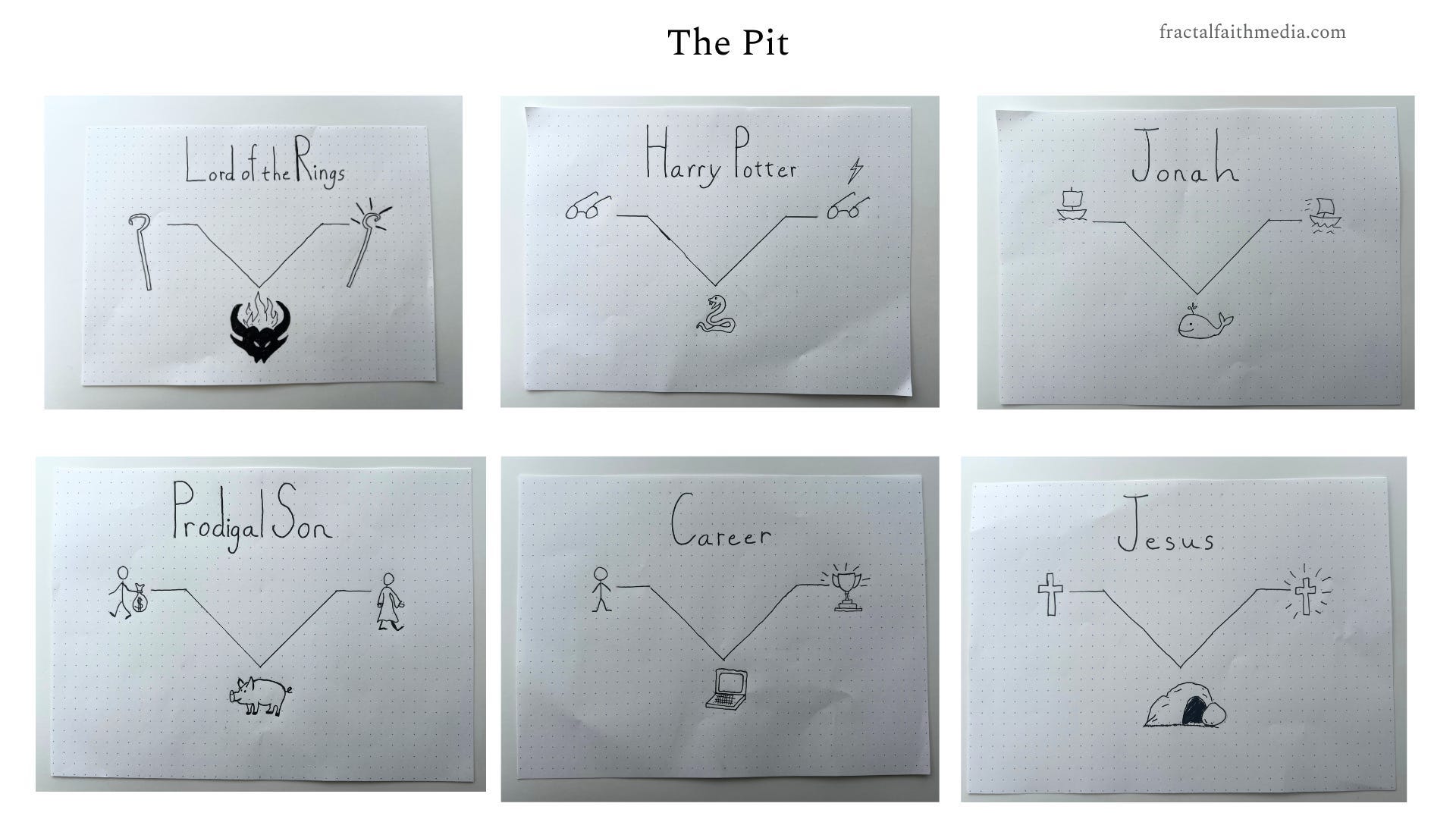
Now that we understand fractals and the concept of the Logos and logoi, we know that the incarnation applies at every scale. Not just Christ, but our everyday lives.
I once heard Jonathan Pageau use the example of a person’s career, and I think it’s perfect.
Our Careers as Fractal
We are born and become children. When we reach our late teens, we leave childhood and enter adulthood, at which point we take up a vocation. We begin our careers.
This leaving of childhood and entering adulthood is where we enter the test, or challenge. Our skills meet reality as we both win and lose battles. Over the decades, if we keep getting back up after we fall, we forge our character. And we’re rewarded at the end. We leave the battlefield and enjoy our well-earned rest. In modern day, we call this phase retirement.
That’s the major arc: Childhood > Career > Retirement. It’s the Pit pattern. Descent into darkness, followed by resurrection.
If that’s the big pattern, we already know it contains smaller patterns. And those smaller patterns follow the same rules.
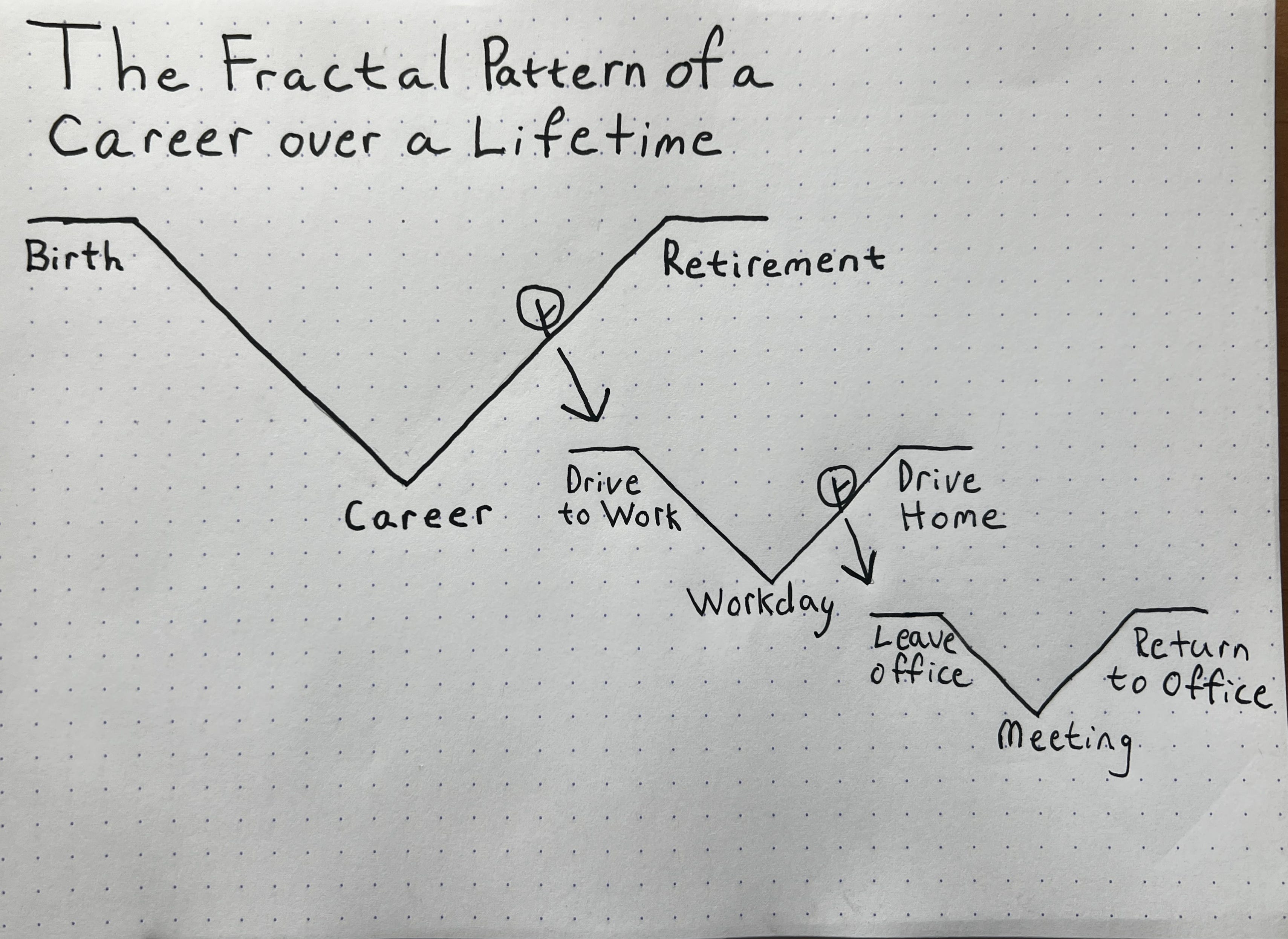
For example, each workday is a model of the pattern of your career. Each day is a test, just like your whole career. Each workday you wake up, walk out the door, get in the car, and leave for work. It’s similar to being born and leaving home once you reach adulthood.
The workday is a miniature version of your career. And within that workday, the pattern repeats.
At 11 am, you leave the comfort of your office and walk into the conference room. Time for your big presentation to the boss.
It opens easily enough, with introductions and a little small talk. Then comes the valley: your boss pushes back in front of everyone, and for a few seconds, you're tested. The dust settles, you get nods of approval, and you return to your office.
After work, you drive home and your spouse awaits with a glass of wine. Forty years later, after many of those workdays, you’re rewarded with retirement. You’re gifted a gold watch.
I sketched this visual showing this fractal pattern of a person’s career.
Why Does Seeing Fractally Matter?
Seeing your career as a fractal is useful, although I wouldn’t say utility is the primary benefit. I’m more so trying to point out the pattern of Christ, of the Incarnation, in our everyday lives.
Still, it’s helpful to look at the benefits, which I’ve personally enjoyed. The benefits flow from what I said earlier about fractals: the same rules apply at every scale.
For one, noticing these patterns helps you develop mental endurance. For me, as an entrepreneur trying to bring ideas into the world, I now realize that the Pit is part of the journey. I’m no longer as discouraged by setbacks and failures. I understand they’re part of the pattern.
Speaking of rules, a country song I love comes to mind: If you’re going through hell, by Rodney Atkins.
Read these lyrics and try to spot the Pit pattern:
Well you know those times when you feel like there’s a sign there on your back
Things go from bad to worse
You think they can’t get worse than that
And then they do— Rodney Atkins, “If You’re Going Through Hell”
The rule Atkins proposes: If you’re going through hell, keep on going.
Rules don’t only exist for the bottom of the Pit, however. Rules exist in the upper-right quadrant, too. That’s where you achieve glory.
For glory, one rule I took far too long to learn: celebrate your wins. When you accomplish something, go through the ritual of celebration. Don’t skip it.
And don’t celebrate just for the psychological reasons so many modern experts champion. Do it because you’re modeling the pattern of Christ, which is the pattern of reality.
See this verse from the book of Timothy in the New Testament:
He appeared in the flesh,
was vindicated by the Spirit,
was seen by angels,
was preached among the nations,
was believed on in the world,
was taken up in glory.1 Timothy 3:16
He ascended in glory. Glory is a state of honor or achievement that invites celebration. When the sports team returns home in glory, they celebrate. When you retire from your career, celebrate.
But don’t only celebrate the big instances of glory.
Fractal thinking teaches us otherwise. Celebrate the small wins, too. Just do it proportionally. A good day at work? Enjoy a glass of wine. A promotion? Take that luxury vacation.
The same rules apply at every scale.
The Fractal Pattern in Art
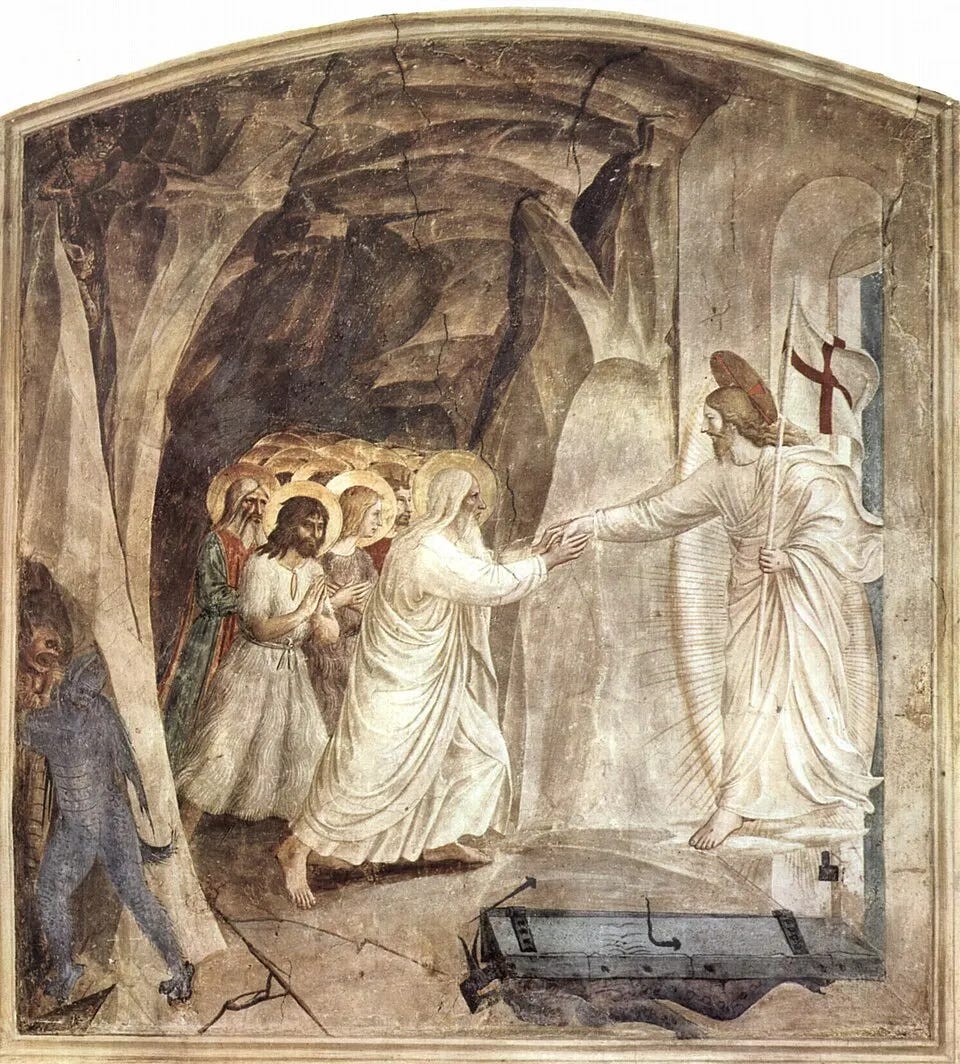
This incredible painting by Fra Angelico focuses on the scene after Christ has died, and before Christ’s resurrection. This event is called the Harrowing of Hell. Christ enters hell and defeats it, saving the souls that were trapped. You can see him grabbing Adam’s hand, followed by Eve and John the Baptist.
Notice two things in this painting:
The fractal nature: Christ dies (1) and, once in Hell, (2) defeats death.
Christ fixes what Adam broke, redeeming Adam. That’s why Christ is often called “The New Adam.” It’s once again the pattern of death and resurrection.
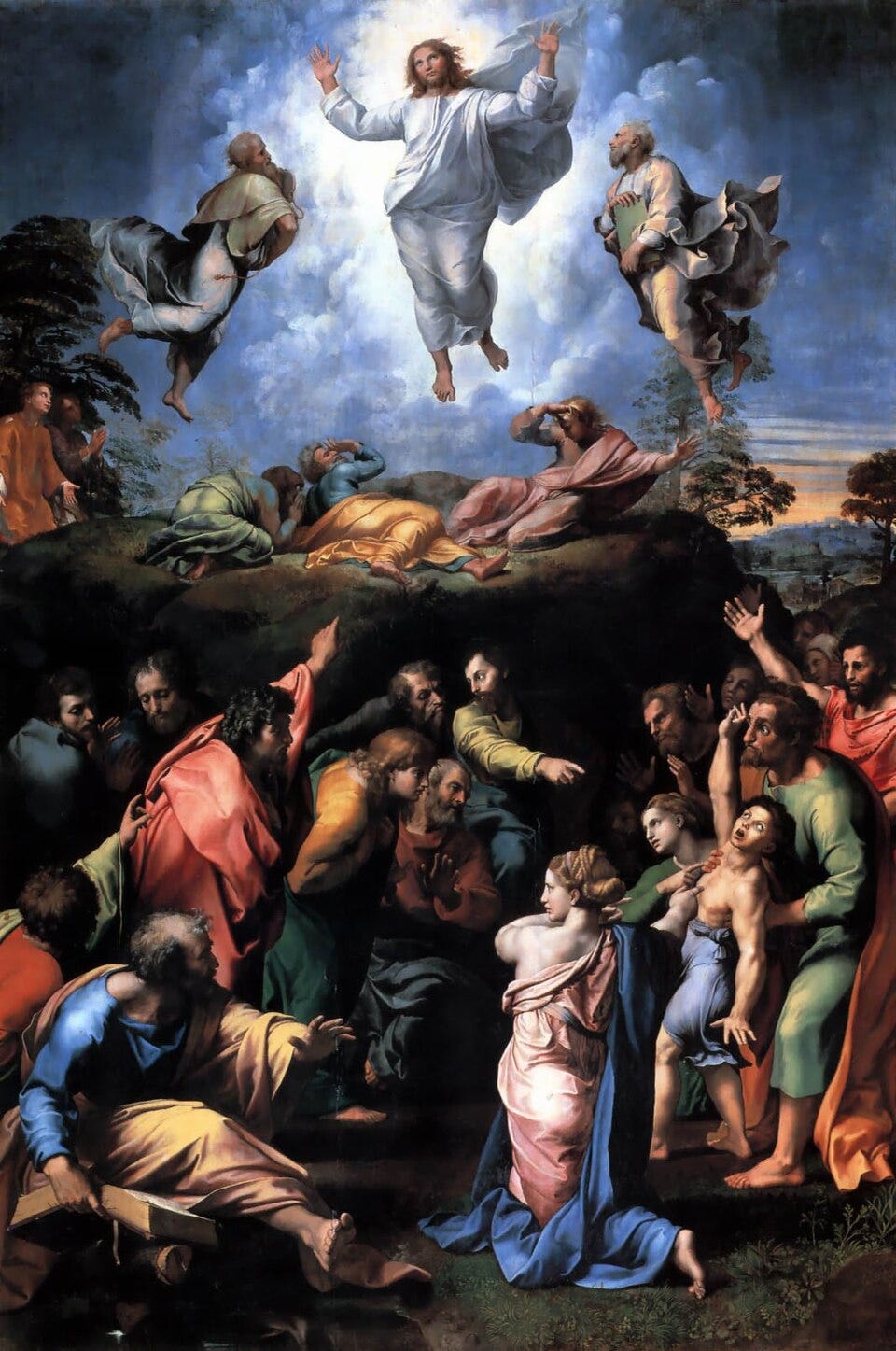
You can see the entire arc in Raphael’s Transfiguration. It depicts the moment Christ is transfigured before Peter, James, and John.
His face shines with divine glory, a preview of his resurrected body. And, according to the Christian tradition, a glimpse of humanity’s final destiny.
Christ stands at the peak of the mountain. Your eye moves naturally downward… to Moses and Elijah, the apostles, the crowd… finally to the demon-possessed boy at the bottom.
The composition shows the pattern:
Christ
Moses and Elijah
The apostles
The crowd
The demon-possessed boy
Modern people often assume hierarchy is about worth. Christianity sees hierarchy differently. It’s about roles, purpose, and ultimately—service. The closer a person is drawn to Christ, the greater the responsibility to pour themselves out for those below. This is demonstrated Biblically when Christ washes the feet of his Apostles.
Paul makes the same claim about Christ, writing to the Colossians:
“For in him all things were created: things in heaven and on earth, visible and invisible, whether thrones or powers or rulers or authorities; all things have been created through him and for him. He is before all things, and in him all things hold together.”
Colossians 1:16-17
Here’s what I’ve come to realize…
Reality is tiered, not flat.
Everything participates in what’s above it. When I attend church, I walk from the outside world into the nave, a holy place. At the front is the sanctuary, and within it the altar and tabernacle, the holiest place.
It’s a hierarchy of holiness.
Christ the Logos is both the source of that structure and its destination. Remember the words from Colossians: through him and for him. Cause and destination.
Every career, workday, meeting, or other Pit is moving toward Christ, whether you notice it or not. He completes everything because everything finds what it’s for, its purpose, in him.
We all see the same world… beauty, love, moral intuition… and patterns repeating everywhere, from DNA to galaxies. Christianity shows us the deeper structure holding all of it together.
This view of Christianity is the one I wish I were given as a kid. I’d have paid far more attention in class. Christianity explains why anything exists, what the universe is, what human beings are, and how knowledge is possible.
It’s the only explanation I’ve found that gives a satisfying account for our world.