

My most memorable experience with The Pit was when I went snowboarding and thought I might die.
My best friend had just moved to Colorado. We snowshoed six miles into a ghost resort—a ski area abandoned for decades—carrying our boards and gear through the frost. Somewhere in the journey, I stumbled down a ravine and nearly into a river, my boots touching the freezing water.
That was close enough to scare the life out of me.
It took all my energy to climb out. We trudged up the old pre-cut slope to the ski patrol hut at 13,000 feet. In the morning, we were treated to sunshine and fresh powder.
I had to go down before I could go up.
This is the fifth post in Fractal Faith. If you’re new here, my first article makes the foundational claim: that Christianity is an explanation of reality, not merely a religion.
Now, we’ll go deeper.
In Fractal Faith, I’m going to show you patterns. Structural patterns that appear at every scale of reality, from biology to mythology to your own life.
You’ve probably seen that Bob Marley poster, the mosaic made from hundreds of tiles, each tile a tiny photograph. Step back, and they resolve into a single face.
When I stand back and look at the poster of reality, I see the face of Christ. One pattern isn’t a shocker, but ten gets interesting. You begin to think, “This is not a coincidence.”
The Pit is one tile. Now, let’s look at it closely.
Example of The Pit
Jonah is in a whale. Pinocchio, too. Gandalf is dragged into Khazad-dûm, and Little Red Riding Hood is swallowed by the wolf. Odysseus descends to meet the dead, and Cooper tumbles into a black hole. Joseph is at the bottom of a pit. Harry Potter, too.
Once you see this pattern, you can’t unsee it. It’s The Pit.
You see it in mythology, fairy tales, blockbusters, Scripture, psychological studies, and the lives of people you know.
Every tradition has a version of it:
The person descends into darkness.
There is a “cave”.
Something happens in the cave.
The person emerges transformed.
No, this isn’t just the hero’s journey that screenwriters teach. It’s the meta-pattern the hero’s journey is based on. And the hero’s journey is just one of many contexts in which The Pit is revealed.
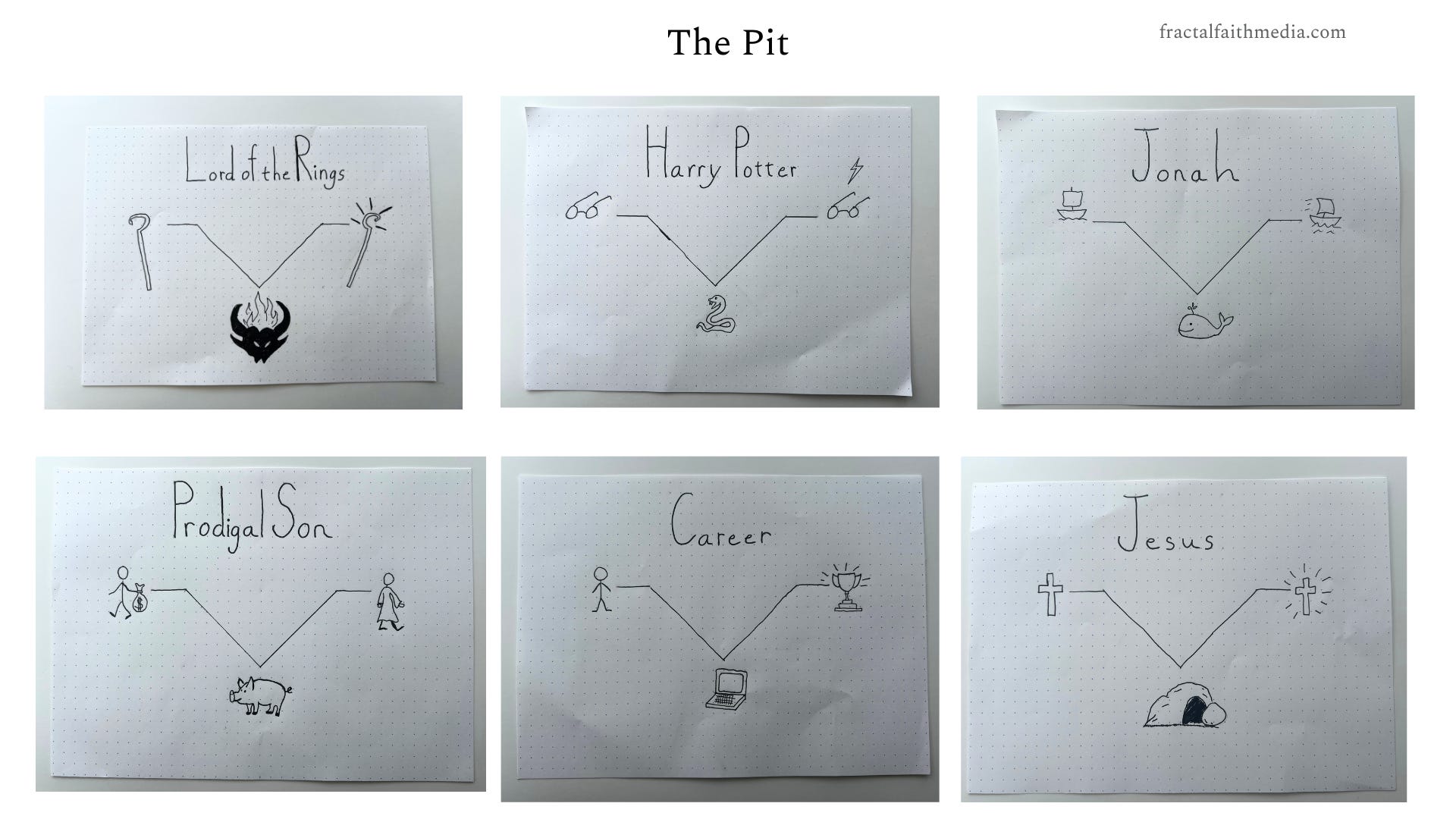
Let’s look more closely at examples. The symbol in parentheses will be shown in the hand-drawn illustrations below.
Lord of the Rings - Gandalf the wizard (staff) is fighting an ancient demon, the Balrog (demon face). The Balrog falls into the pit, a deep mine beneath a mountain (The Pit).
The Balrog pulls Gandalf down with him, and they fall into a pool of water. The water is significant. In this scene, the water symbolizes Gandalf's baptism into his new life.
He finally achieves his new life after battling the Balrog all the way back up to the top of the mountain. On top of the mountain, nearly dead, Gandalf slips away into a sort of dream state.
When he returns, he’s Gandalf the white (enhanced staff), who has new powers and abilities. Same Gandalf, but transformed. His friends don’t even recognize him at first. Kind of like how the resurrected Jesus wasn’t recognized by his friends at first.
Harry Potter - The Harry Potter story involves many descents into The Pit, but one instance makes The Pit especially obvious. It’s when Harry (glasses) descends into a subterranean cavern known as the Chamber of Secrets (The Pit).
In the Chamber, Harry battles the Basilisk (snake), a serpent-like monster. The monster is notable because The Pit is associated with chaos, and monsters are symbols of chaos, the embodiment of the unknown, danger, and the uncontrollable.
The Pit… darkness… chaos… the unknown… monsters… are you seeing the pattern?
After a difficult battle, Harry defeats the Basilisk and leaves the Chamber by flying out of the entrance while holding onto a Phoenix. Harry is upgraded (enhanced glasses) in a number of ways.
Jonah - Jonah (boat) is a prophet who refuses his calling. God tells him to go to Nineveh, but Jonah runs the other direction and boards a ship. A storm rises, Jonah takes responsibility for betraying God, and the sailors throw Jonah overboard (The Pit).
He’s swallowed by a great fish. Belly, darkness, three days.
Jonah prays: “Out of the belly of Sheol I cried, and you heard my voice.”
The fish vomits him onto dry land. The transformed Jonah (fast boat) goes to Nineveh, where everyone in the city repents and returns to God.
Before The Pit, Jonah was on a boat moving in the wrong direction, running away from his calling. After The Pit, he moves toward it.
One detail worth noticing: Jonah spent three days in the whale’s belly. Jesus spent three days in the tomb.
Prodigal Son - The younger son (stick figure with money bag) demands his inheritance early, the cultural equivalent of telling his father “you’re already dead to me,” and leaves home for a life of self-indulgence in a distant land.
His money runs out. A famine hits, and the Prodigal Son resorts to feeding pigs (pig), the lowest possible place for a Jewish man. He’s hungry enough to eat the slop he’s giving the animals.
Something happens in the darkness (The Pit). He sees clearly and decides to go home.
While he’s still a long way off, his father sees him and runs to him. The transformed Prodigal Son (stick figure in robe) is given a robe, a ring, sandals, and a feast.
The “dead” son is now alive
Your Career - You leave the comfort of childhood and the home you grew up in (stick figure).
You build your skills, find your work (laptop), and are constantly tested. When you succeed, you climb. When you don’t, you fall.
Any career has ups and downs, but your entire career—which spans your lifetime—is an example of The Pit.
At the end, you retire (trophy) and come out the other side a changed person.
Jesus - Finally, we arrive at Christ. My argument is that this is the meta-pattern. Christ is the bell that rings in a cave, and every other example is merely an echo.
Christ’s descent begins before the cross. God (plain cross) takes on flesh—the infinite becomes finite—and the eternal enters time. That’s already a descent.
Then the betrayal, the arrest, the trial, and the cross. Then physical death and the tomb for three days.
At this point, every other figure in this list was the edge of the pit, the place they approached but didn’t fully enter. Christ enters it completely and even descends into Hades. On the third day, the tomb is empty.
Jesus is not resuscitated, but resurrects… on his own. We’ll return to that idea in a future article.
Christ resurrects as the same person. Thomas even puts his fingers into the wound. But Christ is transformed beyond recognition. He walks through walls, appears and disappears, and looks so physically different (radiant cross) that even his closest friends don’t recognize him.
Those are just a few examples of The Pit. See the drawings below for their visuals. Notice the V-Pattern. It’s an important pattern to get familiar with.
(Personal note: I have little to no experience drawing, but I’ve always wanted to. I’m using this opportunity with Fractal Faith to develop that skill. No doubt I’ll visit “the pit” numerous times during this endeavor.)
The Pit in Art
Do these paintings of Biblical stories hit differently after learning about The Pit? Can you identify which stage in the V-Pattern each represents?

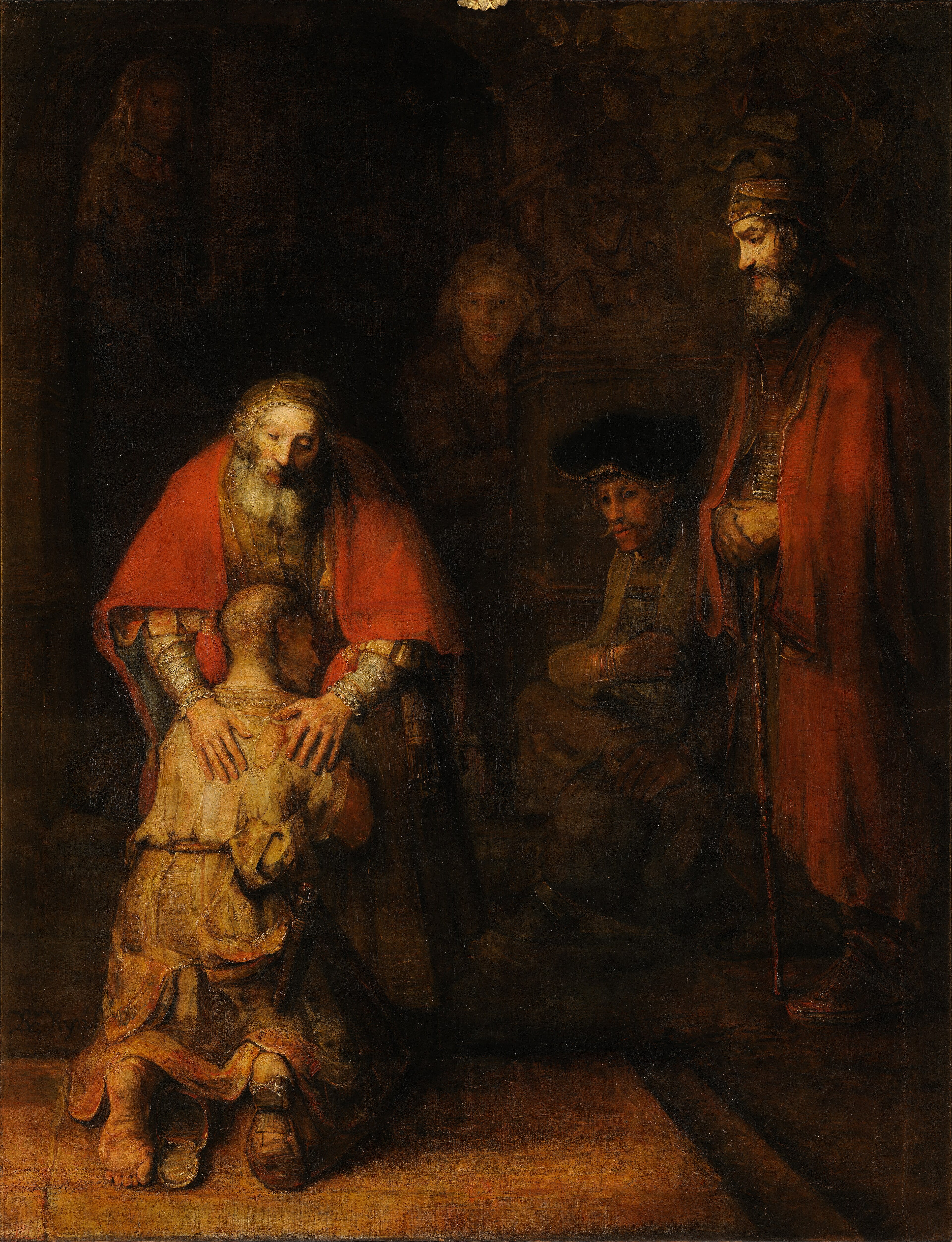
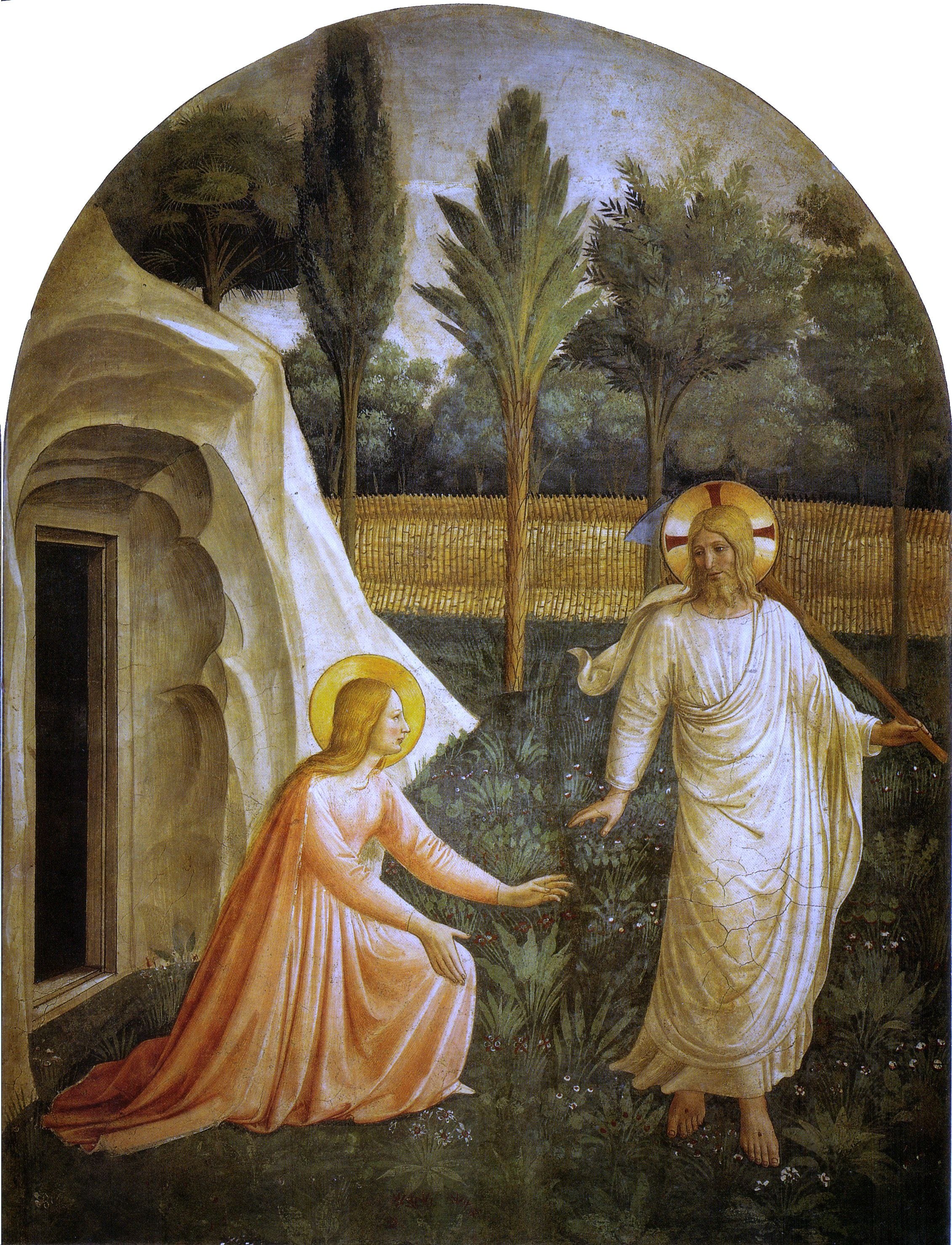
Top: Jonah emerges from the Whale. Jan Brueghel the Elder, c. 1600. Middle: Return of the Prodigal Son, Rembrandt van Rijn, c. 1668. Bottom: Christ emerges from the tomb, Fra Angelico, Noli Me Tangere, c. 1440. All works public domain.
In Music
Many songs use the language of the Pit, both in the musical notes themselves and in lyrics.
Below is an example of The Pit from the song "All is Well" by folk singer Avi Kaplan, who frequently incorporates spiritual symbolism.
I dove into the dark
I swear I almost drowned
But I could see the stars looking up
As I was sinking down- “All Is Well,” Avi Kaplan, I’ll Get By (2021)
The Pattern, Broken Down
The pattern of the Pit goes like this.
Descent
Something pulls you under. Jonah gets thrown off a boat. Gandalf falls into Khazad-dûm.
Darkness
Everything you relied on stops working and you’re stripped down to the bare essentials.
Moses spent forty years in the desert. The Palace, royal status—all of it gone. Tony Stark is tossed into a cave, stripped of his next-level technology, with only a car battery keeping him alive.
Transformation
In the dark, if you survive, something changes you. The pit burns off whatever part of you was fake. What’s left is the real you, and that real part starts to grow. You return, but you’re not the same person.
The prodigal son gets humbled enough to return home. Gandalf the Grey returns as Gandalf the White. Harry Potter survives, earns his lightning-bolt scar, and gains powers like being able to speak to snakes.
The person who emerges from The Pit doesn’t just survive, as surviving means you merely made it through. Transformation means you have emerged as a different person.
Your wounds fade, but remain as proof of your time in The Pit.
The Biggest Pit of My Life
I used to think my life was so unique. As I got older and looked back, I saw that it fit these patterns. Especially one instance that stands above the rest, my deepest journey into The Pit.
That journey stripped me of everything I had built my identity around: my business, my savings, my engagement, and the future I thought I was building. All collapsed at once.
I kept fighting, even at rock bottom. Eventually, I came out.
I rebuilt my career, met my wife, started a family, and I found myself holding gifts I never could have imagined before the descent.
It’s created an interesting tension. On the one hand, I’d rather not endure more suffering. On the other hand, I’m only the person I am because of my journey through The Pit.
In the upcoming posts in this series, I’ll share:
The fractal nature of the Pit
Why Christ is the source of this pattern
Other patterns you often find with The Pit
This is Fractal Faith. Reality at every scale, all traceable back to one meta-pattern, the Logos.
That is, Jesus Christ.
The part that stuck with me was that the pit burns away the fake and the real you is left. That's the part that grows. It reminds me that real growth and transformation cannot be built on anything other than truth. Because truth was built to last. And the only truth we can build and rely on is Jesus Christ.
Billy this is OUTSTANDING. Keep the good (God) stuff coming dude. You have a gift and it’s so appreciated to see how you honor God through it.